Every value proves where it came from.
Or it says so.
Tracefield shows you, on the page, exactly where every number came from — and flags the ones it can't prove.
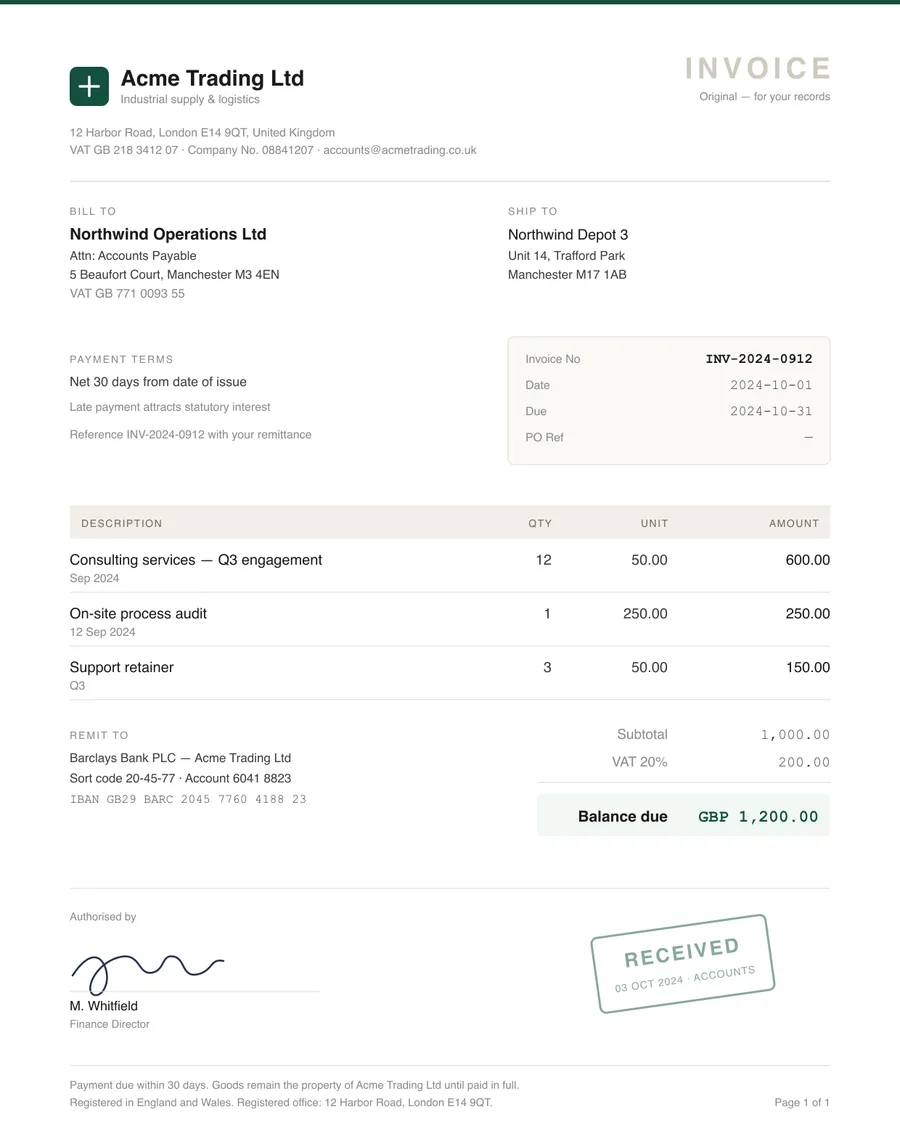
Proof, not promises.
Every extraction tool claims accuracy. The question your auditor will actually ask is: how do you know this number is real? With Tracefield, the answer is one click.
It reads the document, not the vibes.
Every value is pulled from the words on the page — and the model must hand back the exact words it read, so there is nothing to take on trust.
- OCR word stream with coordinates for every word
- The model returns each value with its verbatim quote
- Quotes are matched back against the page, not assumed
- A quote that isn't on the page fails the field
Red claims get a detective.
When a value fails verification, the Review Agent works the case before a human sees it — searches the word stream, reads the page around the label, cross-checks the document's own arithmetic, ranks the reference data — then recommends.
- A bounded tool loop — every call lands in a persisted trace
- One agent, two engines: raw loop and LangGraph, evaluated 4/4 each
- Spend is checked before every model call, not reported after
- It recommends; a person decides, under their own name
What it can't prove, it won't pass.
A value with no source on the page is routed to your review queue — clearly marked — instead of flowing silently into your ERP. That is the whole product.
- Unverified never auto-passes — the database refuses the row
- A person approves, corrects, or rejects, by name
- Every decision lands in the audit trail
- Corrections feed back into future extractions
Only what it can prove leaves the building.
The spreadsheet your team actually works from is filled by verified values and human decisions — and by nothing else. A cell nobody could stand behind exports empty, with the reason beside it.
- A cell is an auto-verified claim or a person's decision
- Withheld cells are counted, named, and announced in the response
- Fields marked redact never leave, in any format
- CSV, JSON, or straight into an agent over MCP
Measured, not asserted.
A tool that is 95% right but can't tell you which 5% is wrong makes you check everything by hand. What matters is whether it knows which answers to stand behind — so that is what we measure.
The rest of the workday.
A verification engine nobody can run all day is a demo. These are the parts that make it a tool: batches, corrections, catalogues, and a way out that is not a screenshot.
Your document types, your fields
Name a type, define what to pull from it, and the fields become the question every extraction answers. A type with no fields cannot be uploaded against — the product refuses to extract nothing and call it success.
Batch upload
Drop in a folder's worth. Three run at a time, each reports its own outcome, and 'seven of nine worked' is an answer — a single spinner over nine files is not.
Review at keyboard speed
j and k walk the fields, a approves, e opens the correction, r marks it absent — and a decision moves you to the next thing waiting. The keys can do exactly what the buttons can do, and nothing more.
Reference catalogues
Upload your supplier list or chart of accounts and a value found on the page can be corroborated against what you already know. Corroborated — never substituted: a match is not evidence that the words were there.
Change the schema, ask again
Add a field in month three and the documents from month one can be run again from their stored originals — priced in the sentence above the button, with every previous answer and review left intact.
Agents, over MCP
Connect Claude and it reads each field with the page's own words behind it. There is no tool for recording a review: an agent can investigate and recommend, but the decision carries a person's name.
Simple pricing, honest meter.
Priced per document processed. Every plan includes the full verification engine — we don't sell trust as an add-on.EARLY ACCESS — free plan only for now
For trying it on your own documents.
- ✓5 documents / month
- ✓Every value traced to the page
- ✓Review queue and audit trail
- ✓Community support
For teams processing invoices every week.
- ✓500 documents / month
- ✓Unlimited document types and schemas
- ✓Review Agent on every failed claim
- ✓Verified-only export, API and MCP access
- ✓Email support
For daily volume across a finance team.
- ✓2,500 documents / month
- ✓Signed webhooks and reference catalogues
- ✓Priority support
- ✓Onboarding call
EARLY ACCESS — EVERY PLAN IS FREE WHILE WE ONBOARD DESIGN PARTNERS. BILLING RUNS THROUGH PADDLE, WHO ACT AS MERCHANT OF RECORD. NEED MORE VOLUME, SSO OR SELF-HOSTING? GET IN TOUCH.
Built to be verified, not believed.
The invariant is enforced by the database, not by good intentions — a verified verdict is unreachable without evidence, by constraint. The runtime is MIT-licensed, the eval suite gates every merge, and seven acceptance proofs kill workers mid-run to check the claims that only matter when demonstrated.
check (verdict <> 'passed'
or evidence_type is not null)
Our own CI lied to us once
The pipeline printed success after a step failed — the exact failure this product exists to prevent, inside the tool built to prevent it. The decision log records it, because the bugs that matter produce plausible output instead of errors.
The baseline gate was wrong first
A gate assumed an extractor that says nothing scores zero. It scores exactly the share of fields that are genuinely absent. It failed a working system, and the fix was to compute the floor instead of assuming it.
The data flywheel lost, on purpose
Retrieving past corrections as few-shot examples moved nothing: +0.0 points, every category — measured on a held-out split with a leakage guard that fails the suite rather than inflating it. Negative results get published here.
Stop spot-checking.
Start tracing.
Five documents free, no card. Every field proves itself — or says so.